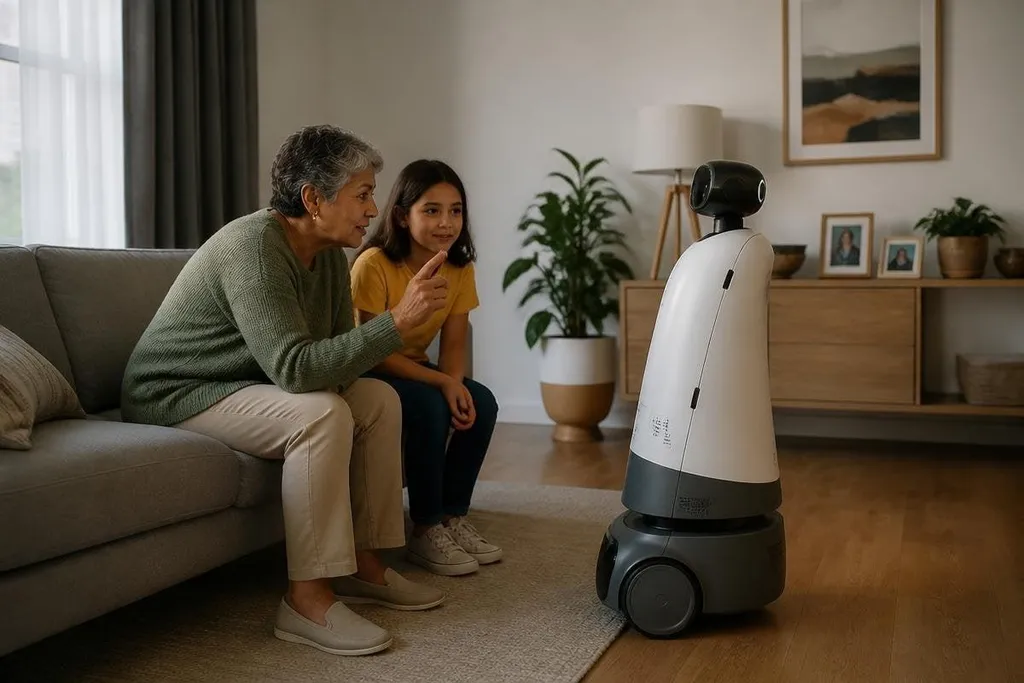
A social robot can speak, look toward a person, and respond to touch. The harder test starts after the first exchange: can it understand the setting, respect limits, and help with a task without creating new work?
For families, care teams, schools, and service operators, that is the question behind newer social robots. The technology needs to move from pleasant interaction to useful, safe behavior that people can check.
Conversation is only the first layer
Speech recognition lets a robot turn spoken words into commands. A camera can help it identify people and objects, while touch sensors can signal contact with a hand or another surface. Those parts give the robot more information, but information alone doesn't tell it what to do.
A useful system needs context. “Bring the book” could mean a book on a table, one on a shelf, or the item a person pointed toward. The robot has to connect speech, sight, location, and recent events before it moves. If it cannot, the person ends up repeating the command or walking over to finish the task.
That makes memory a practical issue. A robot may need to remember a preferred name during a session, while avoiding the storage of private conversations that it doesn't need. Clear controls matter as much as the language model behind the voice.
Social skill must lead to useful action
Many demonstrations focus on eye contact, facial movement, or a natural voice. Those details can make interaction easier, but they don't prove that the robot can support a real routine.
A stronger test links social behavior to a result. The robot asks a person to confirm a medication reminder before speaking. It waits when someone is busy. It repeats a warning when background noise blocks the first attempt. It calls for help when a task falls outside its limits.
These actions depend on timing and restraint. A robot that speaks at the wrong moment can interrupt care work.
One that moves too close can make a shared room harder to use. Social robots should be judged by how well they handle these ordinary moments, not by a polished greeting.
A warm voice doesn't show how a social robot handles refusal or silence. Social robotics reporting from Robot24.com can tie that behavior to a named maker, model, test setting, and date before you decide whether the robot belongs in a shared room.
The hard part is trust
Trust grows when a robot makes its limits visible. People need to know when it heard a command, when it is unsure, what data it stores, and who can review that data. A light, tone, or short spoken message can make the robot's state easier to read.
Safety also has a physical side. A social robot sharing space with children, older people, or patients must control speed, force, and stopping distance. Its software may handle speech well while its motor control still needs close supervision. Those are separate problems, and a friendly voice cannot solve the second one.
Privacy brings another test. Cameras and microphones can collect sensitive details even when the robot performs a harmless task. Operators should be able to turn sensors off, delete stored data, and see which functions need access to each sensor.
I'd judge a social robot by its recovery after confusion, not its best scripted exchange. A system that asks for clarification and stops safely is more useful than one that sounds certain while doing the wrong thing.
A practical check before deployment
A buyer or project lead can use this short check before approving a trial:
- Name the task: Write down the exact job, location, and person who will use it.
- Test confusion: Give unclear commands and record whether the robot asks for more detail.
- Check sensor access: List what the camera, microphone, and touch sensors collect.
- Watch the stop: Confirm that a person can stop movement without reaching behind the robot.
- Measure staff work: Count the setup, corrections, charging, and cleaning each session needs.
- Set the exit rule: Decide which failures end the trial and who reviews them.
This check shifts attention from personality to workload. It also gives a team a way to compare a social robot with a tablet, alert system, or human-led routine before buying hardware.
Newer social robots will earn a place in shared spaces when they can explain their limits, protect private data, and finish a defined task with little supervision. Until makers publish that evidence for real settings, a good conversation remains a demonstration, not a deployment case.